

- 10th Kup Revision Guide
- 9th Kup Revision Guide
- 8th Kup Revision Guide
- 7th Kup Revision Guide
- 6th Kup Revision Guide
- 5th Kup Revision Guide
- 4th Kup Revision Guide
- 3rd Kup Revision Guide
- 2nd Kup Revision Guide
- 1st Kup Revision Guide
- 1st Dan Revision Guide
- 2nd Dan Revision Guide
- 3rd Dan Revision Guide
- 4th Dan Revision Guide
- 5th Dan Revision Guide
10th Kup (White Belt) Grading Requirements
This guide will help you prepare for your upcoming grading. Remember that the actual format may vary at the examiner’s discretion.
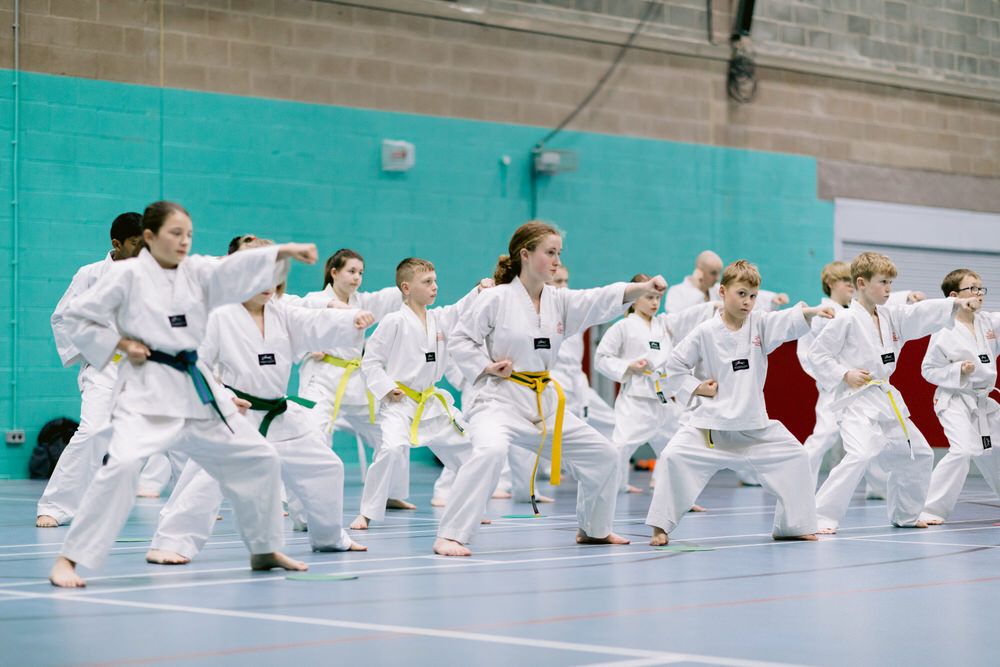
“The journey of a thousand miles begins with a single step.” – Lao Tzu
What You Need to Know
Practical Elements
- Basic Techniques:
- Sitting stance with a single punch
- Front rising kick exercises
- 10 push-ups (proper form)
- Stances and Movement:
- Walking stance with middle section punch (forward and backward)
- Walking stance with a low block and reverse punch (forward and backward)
- Walking stance with middle block and reverse punch (forward and backwards)
- Pattern:
- Sajo Jirugi (4 directional punching)
Theoretical Knowledge
The Meaning of the White Belt
The white belt represents innocence, symbolizing a beginning student approaching Tae Kwon Do with no preconceptions and an open mind ready to learn.
The Five Tenets of Tae Kwon Do
- Courtesy (Ye Ui)
- Integrity (Yom Chi)
- Perseverance (In Nae)
- Self-Control (Guk Gi)
- Indomitable Spirit (Baekjul Boolgool)
Essential Korean Terminology
Numbers:
- 1: Hanna
- 2: Dool
- 3: Seth
- 4: Neth
- 5: Dasaul
- 6: Yosaul
- 7: Ilgop
- 8: Yodoll
- 9: Ahop
- 10: Yoll
Commands:
- Attention: Charyot
- Bow: Kyong Ye
- Ready: Chunbi
- Start: Si-jak
- Stop: Goman
- Return to ready stance: Barrol
- Dismiss: Haessan
- About turn: Dwiyro Torro
Stances:
- Attention Stance: Charyot Sogi
- Parallel stance: Narani sogi
- Sitting Stance: Annun Sogi
- Walking Stance: Gunnun Sogi
Directions:
- Forwards: Apro Kaggi
- Backwards: Dwiyro Kaggi
Sections:
- High Section: Nopunde
- Middle Section: Kaunde
- Low Section: Najunde
Body Parts:
- Forearm: Palmok
- Inner Forearm: An Palmok
- Outer Forearm: Bakat Palmok
- Forefist: Ap Joomuk
Techniques:
- Obverse punch: Baro jirugi
- Reverse punch: Bandae jirugi
- Inner forearm block: An palmok makgi
- Outer forearm block: Bakat palmok makgi
- Front Rising Kick: Ap Chaolligi
- Side rising kick: Yop chaolligi
- Four Directional Punch: Sajo Jirugi
Other Terms:
- Tae Kwon Do: Foot-Fist-Art
- Belt: Ti
- Training Suit: Dobok
- Training Hall: Dojang
- Instructor: Sabum
- Student: Jeja

Sajo-Jirugi No.1 (Four Directional Punch)
Number of Movements: 15 Starting Position: Parallel ready stance
- Move right foot forward to A, forming a right walking stance with an obverse middle section punch.
- Return right foot to the left, then step back to form a left, walking stance toward B with an obverse low section outer forearm block.
- Move right foot forward to B, forming a right walking stance with an obverse middle section punch.
- Return right foot to the left, then step back to form a left, walking stance toward C with an obverse low section outer forearm block.
- Move right foot forward to C, forming a right walking stance with an obverse middle section punch.
- Return right foot to the left, then step back to form a left, walking stance toward D with an obverse low section outer forearm block.
- Move right foot forward to D, forming a right walking stance with an obverse middle section punch.
- Return right foot to parallel ready stance facing A
- Move left foot forward to A, forming a left walking stance with an obverse middle section punch.
- Return left foot to the right, then step back to form a right walking stance toward D with an obverse low section outer forearm block.
- Move left foot forward to D, forming a left walking stance with an obverse middle section punch.
- Return left foot to the right, then step back to form a right walking stance toward C with an obverse low section outer forearm block.
- Move left foot forward to C, forming a left walking stance with an obverse middle section punch.
- Return left foot to the right, then step back to form a right walking stance toward B with an obverse low section outer forearm block.
- Move left foot forward to B, forming a left walking stance with an obverse middle section punch.
- End: Return left foot to parallel ready stance.
Sajo-Jirugi No.2 (Four Directional Punch)
Number of Movements: 15 Starting Position: Parallel ready stance
- Move right foot forward to A, forming a right walking stance with an obverse middle section punch.
- Return right foot to the left, then step back to form a left, walking stance toward B with an obverse middle inner forearm block.
- Move right foot forward to B, forming a right walking stance with an obverse middle section punch.
- Return right foot to the left, then step back to form a left, walking stance toward C with an obverse middle inner forearm block.
- Move right foot forward to C, forming a right walking stance with an obverse middle section punch.
- Return right foot to the left, then step back to form a left, walking stance toward D with an obverse middle inner forearm block.
- Move right foot forward to D, forming a right walking stance with an obverse middle section punch.
- Return right foot to parallel ready stance facing A
- Move left foot forward to A, forming a left walking stance with an obverse middle section punch.
- Return left foot to the right, then step back to form a right walking stance toward D with an obverse middle inner forearm block.
- Move left foot forward to D, forming a left walking stance with an obverse middle section punch.
- Return left foot to the right, then step back to form a right walking stance toward C with an obverse middle inner forearm block.
- Move left foot forward to C, forming a left walking stance with an obverse middle section punch.
- Return left foot to the right, then step back to form a right walking stance toward B with an obverse middle inner forearm block.
- Move left foot forward to B, forming a left walking stance with an obverse middle section punch
- End: Return left foot to parallel ready stance
Practice Tips
- Practice regularly in front of a mirror to check your stances and techniques.
- Focus on accuracy before speed
- Practice Korean terminology daily
- Attend classes consistently before your grading
- Ask your instructor for feedback on areas needing improvement
- Review this guide thoroughly before your grading date
Good luck with your 10th Kup grading!
What are the different Belts in Tae Kwon Do?
White Belt: The starting point in Tae Kwon Do training What are the different Belts in Tae Kwon Do? Tae Kwon Do, a Korean martial art known for its dynamic kicks and fast-paced movements, offers individuals of all ages and fitness levels the opportunity to learn self-defence skills, improve their physical fitness, and cultivate discipline…Is Tae Kwon Do or Karate better?
Is Tae Kwon Do or Karate better? The answer depends on your personal goals and preferences, as martial arts offer unique benefits and philosophies. Origins and History One of the most fascinating aspects of martial arts is their diverse origins and rich historical backgrounds. Each martial art has unique beginnings, often rooted in ancient cultures…



Contact Us
Your journey in Tae Kwon Do awaits! Sign up for a trial period at your local Tae Kwon Do School.